MSMM Engineering, LLC

Our Projects

Explore our portfolio of engineering projects across the Gulf South

Cow Bayou Drainage Pump Station Complex
Flood Control|In Progress

Cow Bayou Drainage Pump Station Complex

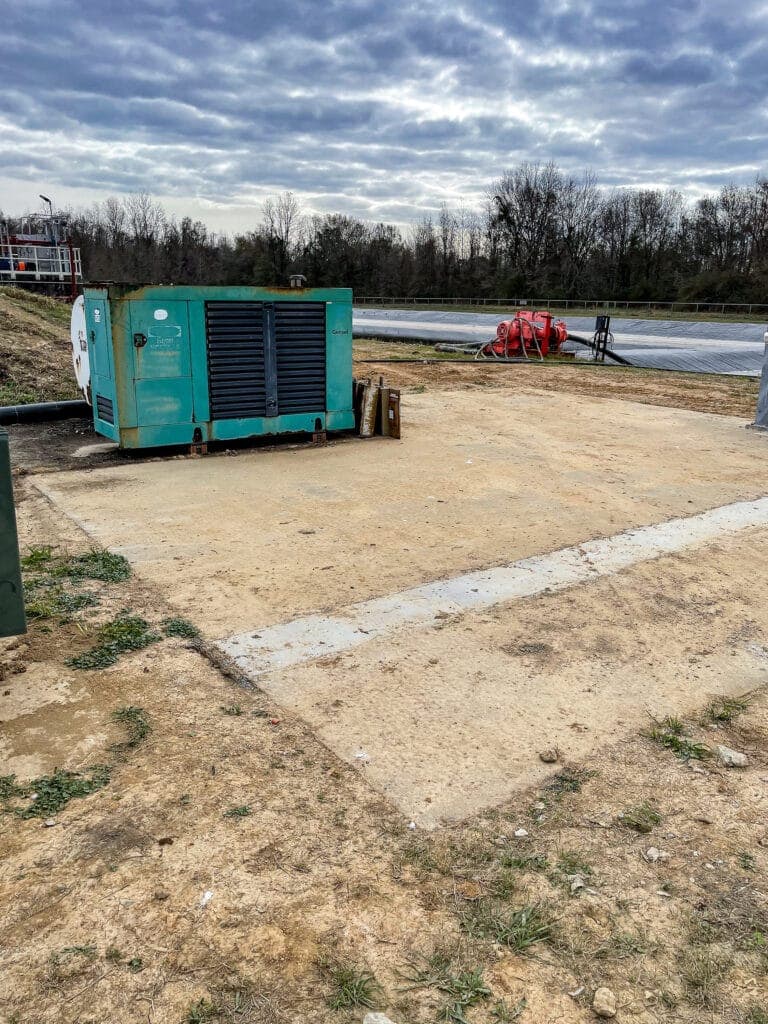
Our team completed 35% design of the 8,190 CFS pump station as part of the Sabine to Galveston Cow Bayou Complex project. The Cow Bayou Complex includes levee tie-ins, floodwalls, sluice gate structures and a sector gate for navigational traffic. The pump station consists of five 1,365 CFS horizontal, vacuum primed pumps requiring 126-inch suction side and 115-inch discharge side with formed concrete intakes; and three 455 CFS vertical self-priming pumps with 84-inch discharge piping. The preliminary design phase was a joint engineering effort between USACE New Orleans District, Galveston District and our team in which we operate as a one integrated design team. Our design responsibility included structural design, architectural design, civil site work, geotechnical evaluation and design, MII cost estimating, CAD drafting and project management. A unique feature of this project design is that we are an integrated design team with the New Orleans District who is providing the mechanical and electrical design while we are responsible for coordinating the mechanical and electrical design with the civil, structural and geotechnical engineering design. Other project features being designed by our team include dolphin structures which protect the facility above the water level from possible boat impact, a pump station safe house, and a fuel farm and access roads. We designed the project in Microstation 3D, also utilizing Revit BIM 3D modeling for the facilities. Preliminary investigations consisted of extensive geotechnical testing to determine soil suitability, preliminary estimates of dredging based on navigational traffic loads in the Cow Bayou area, and structural calculations to determine the required height of the T-walls, and navigational structures. Preliminary architectural work was also completed to design the safe house that is attached to the main pump station building. The safe house includes all facilities and work spaces for the pump station operators. The pump station reinforced concrete structure is 250 FT wide by 128 FT long with 8 pump bays and supported by 100 FT long steel H-pile. The vertical pumps, engines, generators, gear boxes, vacuum pumps and electrical equipment are all housed within the pump station building. The structural steel building located above the concrete pump station structure is 43 FT tall and utilizes 8 IN thick precast concrete tilt up wall panels on all four sides of the building. The roof consists of 6 IN concrete slab on metal roof deck attached to the supporting members maintaining a 1:12 slope. All of these features were designed by our engineers and architects. Our structural engineers, following USACE engineering manuals, designed all permanent project structures associated with the pump station including the horizontal and vertical pump intake and discharge structures, engine and pump support slabs, pump station building, pump station safe house, fuel tank foundation and containment area, water tank foundation, west access bridge, exterior semi-gantry and overhead bridge crane supports, as well as the protective dolphins on the intake and discharge side of the pump station. The pump station and safe house were designed utilizing STAAD software (a 3D structural analysis and design software). Our engineers also reviewed preliminary hydrologic and hydraulic modeling results for the area to set the appropriate protection elevations for all of the risk reduction measures developed as part of this project. The pump station safe house is a two-story structure 36 FT long by 22 FT wide. The building is supported by cast-in place concrete beams and cast-in place concrete columns. The safe house is a separate structure but abuts to the pump station building. The safe house provides housing for four to six emergency personnel that shall be required to man the facility during a hurricane, and it is designed for tornado force winds. The safe house required a 1,000 gallon per day onsite wastewater treatment facility due to the lack of facilities in the project area. Our civil engineering team provided the wastewater treatment facility design. The pump station fuel farm consists of an elevated concrete platform structure with containment walls designed to support the three 16K GAL fuel tanks for the pump station. Adjacent to the fuel farm a 55K GAL above ground water storage tank was included as a backup water supply. The sizing was based on providing emergency water for safe house occupants, pump bearing lubrication and safe house sprinkler operations in the event of an emergency. The geotechnical services included engineering analyses on the soil borings data in which the New Orleans District provided our geotechnical engineers. The team provided recommendations regarding site preparation and drainage, estimates of allowable pile load capacity for support of pump station components and the fuel platform, and estimates of settlement. The geotechnical analysis included performing deep seated stability analyses of the pump station, determining the unbalanced force on the pump station, designing seepage cutoff beneath the pump station, performing analyses to evaluate potential uplift of the pump station during and after construction, determining lateral earth pressures for the wall design, and providing a preliminary design for temporary retaining structures (TRS) to construct the pump station. Analyses were also performed for the design of the dolphins to protect the pump station and gates. As part of our project management activities and coordination between our design team and the USACE mechanical/electrical design team, we prepared a detailed communication plan which outlined procedures for coordination of design activities and the transfer of information between all parties. The plan addressed scheduling, communication distribution structure, information collection and filing procedures, and a flow chart of personnel and project progression. Our team was responsible for combing the design data for each submittal in which we incorporated the USACE-prepared plans, specs and DDR write-ups into our deliverable set. We also prepared the MII cost estimate for the 35% design package. Following receipt of the 35% design package, SWD has engaged CERL/ERDC to complete additional hydrologic and hydraulic modeling and changing the acquisition strategy to Design-Build. Currently, our team is awaiting ERDC to complete updated modeling in order to finalize the design package into a Design-Build RFP package which will occur under a future task order

Orange, TX

CWPPRA Program Scanning, Digitizing, and Document Control System
Database/GIS Mapping|2011|Completed

CWPPRA Program Scanning, Digitizing, and Document Control System

Inventory analysis, need assessment, archive and index Coastal Westland Planning, Protection and Restoration Act (CWPPRA) documents Scanning, digitization, document control system Create database, supply and utilize software for search and retrieval of documents Prepare 21st Priority Project List (PPL) report for CWPPRA Management support for modeling projects, FEMA mapping and modeling documentation QA/QC Project management. This project is primarily based on CWPPRA’s critical need for archiving, storing, and retaining the documents, drawings, maps and artifacts under one centralized system. As well, the 21st PPL report is prepared following guidance provided by the Coastal Wetlands Planning, Protection, and Restoration Act, Public Law 101-646, title III, Section 303, and in accordance with direction from the US Army Corps of Engineers (USACE), New Orleans District (CEMVN). The report is to contain project descriptions, environmental benefit determinations, cost estimates, general supporting information, overviews of the study authority, program capacity, study process and plan formulation. Project Tasks: CWPPRA documentation, digitization, archiving, PPL report preparation, Project Management.

New Orleans, LA

Dallas Floodway 277K Levee Raise and Delta Pump Station
Flood Control|2021|Completed

Dallas Floodway 277K Levee Raise and Delta Pump Station

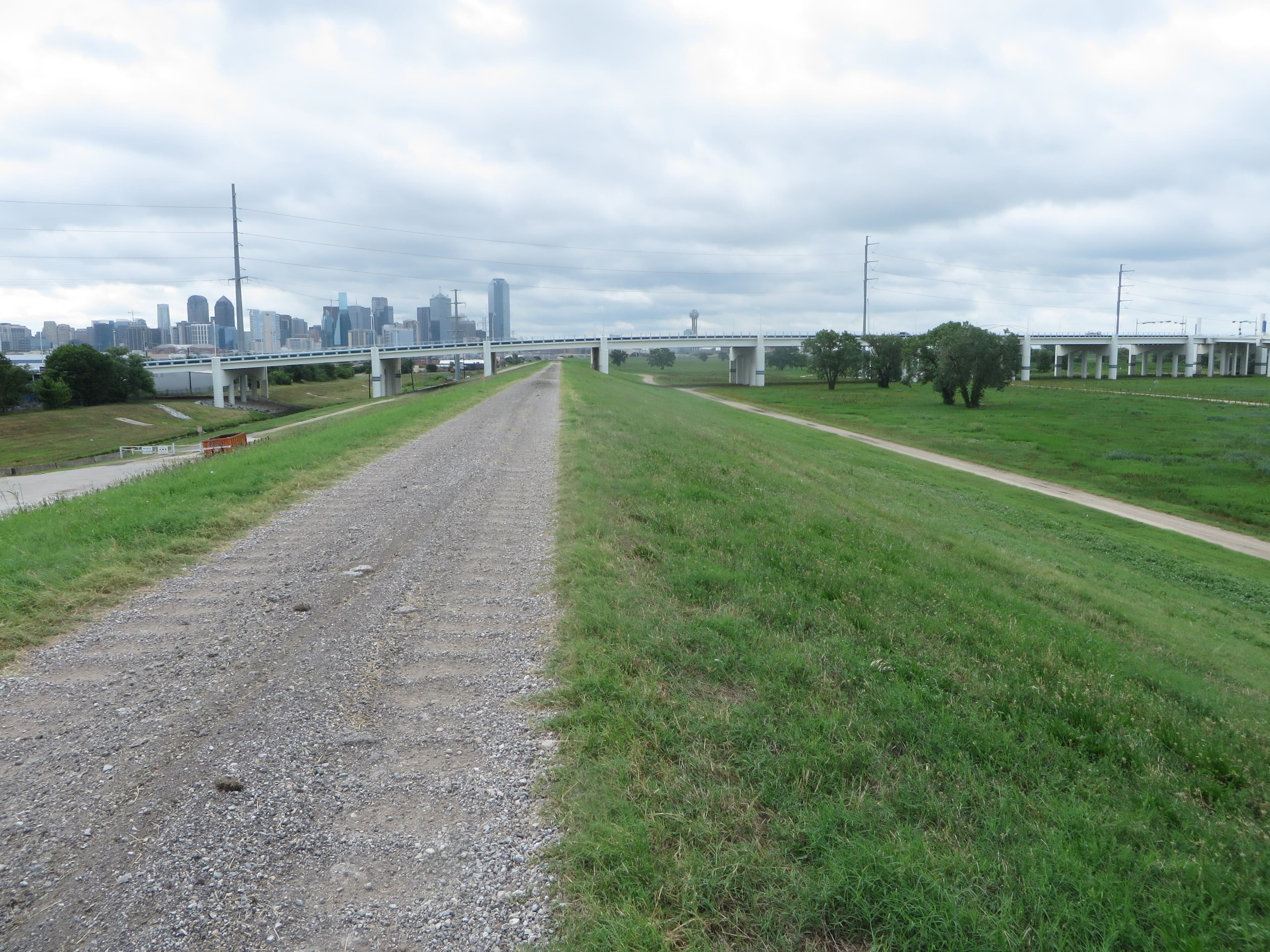
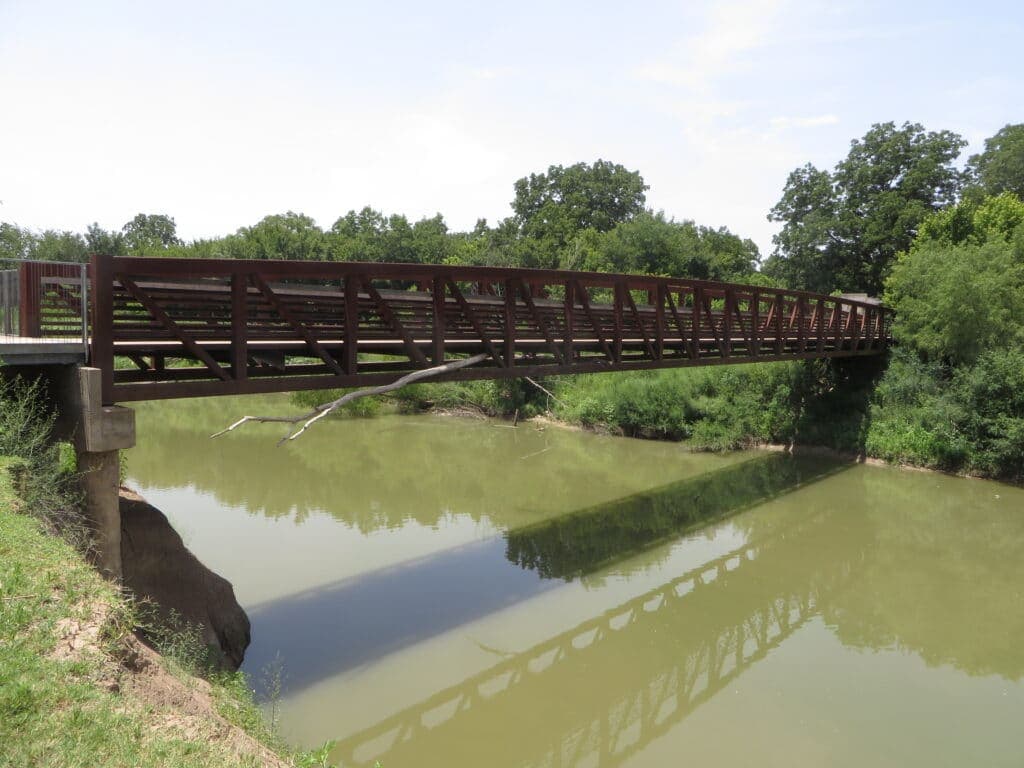
In 2020, MSMM Engineering was tasked by the United States Army Corps of Engineers (USACE) Ft. Worth District to design various recreational, roadway, and bridge features for a public recreational park in South Dallas. This project involved the planning and design of various recreational components on a former golf course in South Dallas. The trail system and bridge features were designed for the United States Army Corps of Engineers (USACE) Ft. Worth District in support of the City of Dallas. The Dallas Floodway extension project consisted of various access routes, walking/vehicular trails, bridges, boardwalks, and platforms. The project provided recreational access to a chain of wetlands designed to provide unimpeded overflow for floodwater along the west side of the Trinity River from the Dallas Floodway to Loop 122. The project continues an overall master planning effort to provide recreational access across Dallas with uninterrupted access. This project provided another 12-miles of multi-use trails, additional parking lots at major trail connection points, three additional bridges, including one larger bridge across the Trinity River, an elevated boardwalk trail for access across a low-lying marshy area, and new birdwatching platforms in the previously created wetlands. The design team also added public safety features including culverting for water distribution, locked gates, and pipe rail fences for the City of Dallas to manage public access, site lighting in the added parking lots, and site signage at the access points for time periods where the recreational areas are flooded, and public access is restricted. Benches were also added at scenic overlooks, wildflower areas and for views of the wetlands. MSMM provided full engineering services to the USACE, including schematic design, preliminary design, and final design. The scope of work included the development of plans and specifications for three (3) bridge crossings, one over the Elam Creek (60 feet), one over the chain of wetlands, and a larger crossing over the Trinity River (150 feet). Additionally, the design package consists of over 10 miles of 12-ft wide multi-use roadway (trail) for vehicular/walking trail access, the restoration of parking lots at trail heads, the inclusion of pipe rail fences and gates to prevent after-hour access, and the design of bird watching platforms over the wetlands. MSMM performed H&H modeling of the Trinity River to help aid in the bridge design process. All roadway/bridges consist of a single lane and were designed to contain the load of school buses/emergency vehicles. Additionally, our team performed detailed cost estimating utilizing MCACES. We also provided design and project schedules utilizing the Primavera suite of scheduling services.

Dallas, TX

Dallas Floodway Extension Recreation Design
Public Infrastructure|2020|Completed

Dallas Floodway Extension Recreation Design

In 2020, MSMM Engineering was tasked by the United States Army Corps of Engineers (USACE) Ft. Worth District to design various recreational, roadway, and bridge features for a public recreational park in South Dallas. This project involved the planning and design of various recreational components on a former golf course in South Dallas. The trail system and bridge features were designed for the United States Army Corps of Engineers (USACE) Ft. Worth District in support of the City of Dallas. The Dallas Floodway extension project consisted of various access routes, walking/vehicular trails, bridges, boardwalks, and platforms. The project provided recreational access to a chain of wetlands designed to provide unimpeded overflow for floodwater along the west side of the Trinity River from the Dallas Floodway to Loop 122. The project continues an overall master planning effort to provide recreational access across Dallas with uninterrupted access. This project provided another 12-miles of multi-use trails, additional parking lots at major trail connection points, three additional bridges, including one larger bridge across the Trinity River, an elevated boardwalk trail for access across a low-lying marshy area, and new birdwatching platforms in the previously created wetlands. The design team also added public safety features including culverting for water distribution, locked gates, and pipe rail fences for the City of Dallas to manage public access, site lighting in the added parking lots, and site signage at the access points for time periods where the recreational areas are flooded, and public access is restricted. Benches were also added at scenic overlooks, wildflower areas and for views of the wetlands. MSMM provided full engineering services to the USACE, including schematic design, preliminary design, and final design. The scope of work included the development of plans and specifications for three (3) bridge crossings, one over the Elam Creek (60 feet), one over the chain of wetlands, and a larger crossing over the Trinity River (150 feet). Additionally, the design package consists of over 10 miles of 12-ft wide multi-use roadway (trail) for vehicular/walking trail access, the restoration of parking lots at trail heads, the inclusion of pipe rail fences and gates to prevent after-hour access, and the design of bird watching platforms over the wetlands. MSMM performed H&H modeling of the Trinity River to help aid in the bridge design process. All roadway/bridges consist of a single lane and were designed to contain the load of school buses/emergency vehicles. Additionally, our team performed detailed cost estimating utilizing MCACES. We also provided design and project schedules utilizing the Primavera suite of scheduling services.

Dallas, TX

East Baton Rouge Parish North Landfill Leachate Pond Abandonment
Ecosystem Restoration|2022|Completed

East Baton Rouge Parish North Landfill Leachate Pond Abandonment

Through a Federal program to fund Environmental Infrastructure programs within local municipalities, MSMM representing the USACE New Orleans District, is working with the East Baton Rouge Parish Government (non-Federal sponsor) on a program to eliminate the onsite lagoon treatment and discharge in favor of a new forcemain and pump station modifications that ties into the city-parish sanitary sewer treatment facilities. This program is being undertaken due to anticipated increases in stringency of discharge limitations into Baton Rouge Bayou; it will eliminate a discharge permit through the LDEQ; and takes advantage of the newly constructed Zachary Area Transmission Network Improvements Project. MSMM was responsible for providing 100% bid ready plans and specifications (in USACE format) for closure and abandonment of the three surface treatment ponds. Design documents addressed methods to drain the ponds; removal and disposal of the existing sewage sludge; removal of the existing levees surrounding the ponds; removal of the HDPE liners; removal of existing treatment equipment including piping, concrete structures, and UV System; and fill and grading of the approximate 6-acre area to return it to the appearance of natural land. Additional services performed by MSMM included survey, geotech, sludge sampling for analysis, MCACES cost estimate, coordination with East Baton Rouge Parish and the landfill operators. Continuing tasks upon completion of the pump station and forcemain construction will be to assist the USACE with bidding and construction services, EA and coordination with the LA Department of Environmental Quality (LDEQ) for closure of the treatment facilities.

Baton Rouge, LA

Farmsite Road Canal Crossing Culvert
Flood Control|2020|Completed

Farmsite Road Canal Crossing Culvert

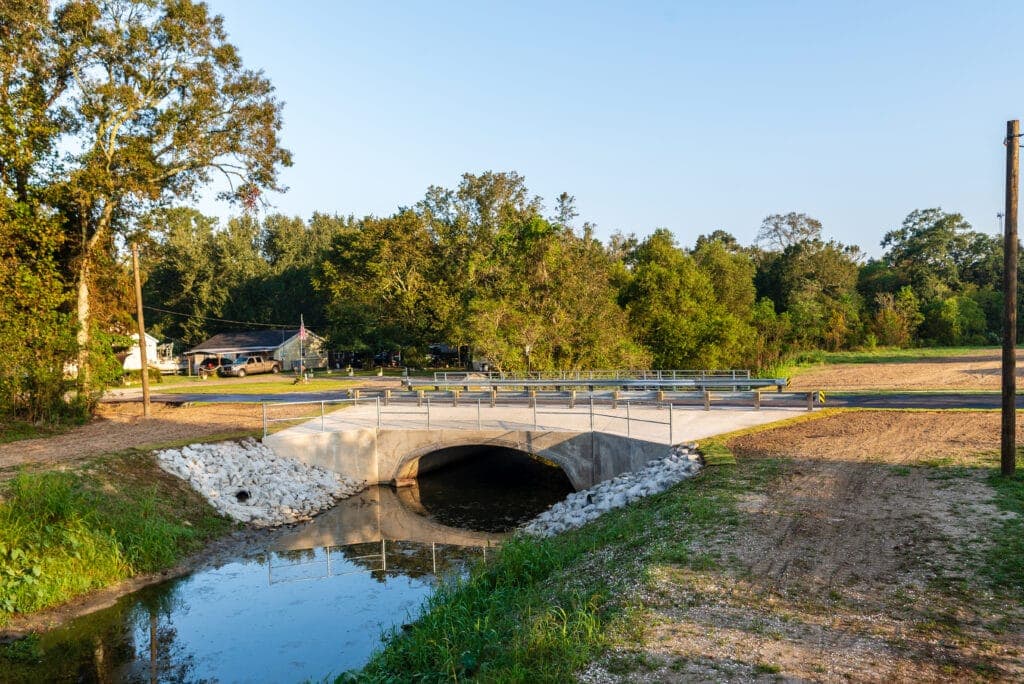
MSMM performed civil and structural design (including schematic, preliminary, and final design), hydraulic modeling, survey services, and construction management for the replacement of an undersized culvert at Farmsite Road and Green Avenue Canal in Violet, LA. The project wrapped up construction in October of 2020 and consists of a pre-cast arch culvert bridge system. MSMM developed a hydraulic analysis of the location including analysis of existing canal flows, existing culvert configuration flows, and optimum flow allowances to account for a large watershed event. Following the completion of the hydraulic analysis, MSMM provided updated information to FEMA for refinement of the project worksheet and used the hydraulic data to determine which Arch Culvert bridge system was best applicable to design. MSMM then designed the pre-cast Arch Culvert bridge replacement, which was approved by FEMA. The project was bid in the Winter of 2019 and MSMM continued to provide construction management and engineering during construction.

Violet, LA

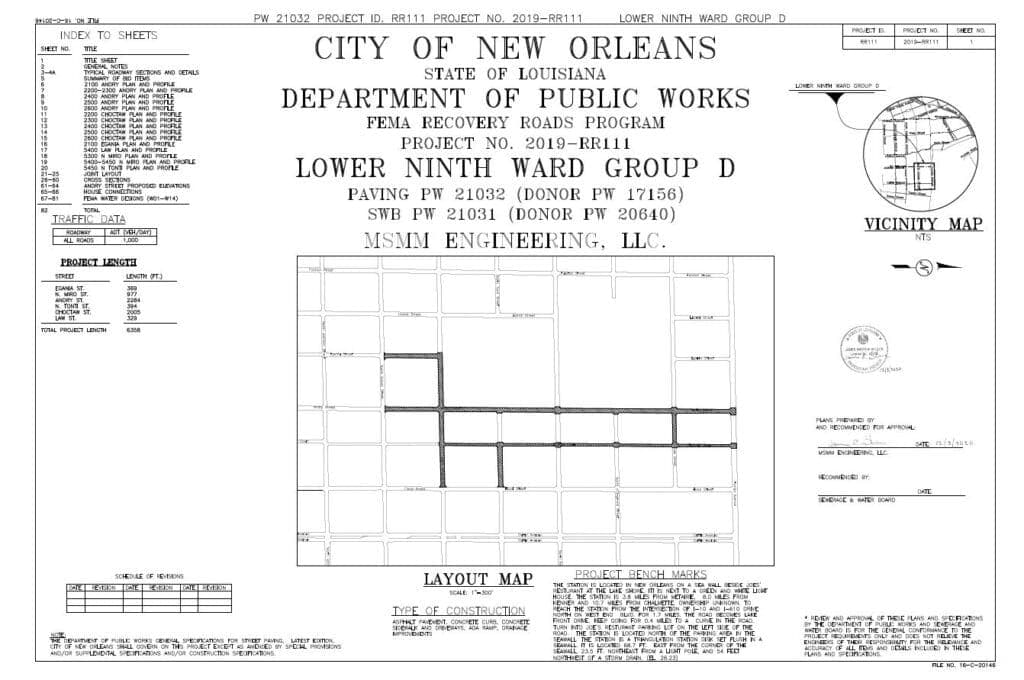
FEMA JIRR — Lower 9th Ward NW Group D (RR111)
Public Infrastructure|Completed

FEMA JIRR — Lower 9th Ward NW Group D (RR111)

MSMM was tasked by the City of New Orleans Department of Public Works with performing full engineering design services on multiple blocks of city streets within the Lower Ninth Ward neighborhood of New Orleans. As part of these design services, the MSMM civil engineering staff was responsible for all impacted concrete and asphalt streets, curbs, driveways, sidewalks, water and sewer relocations, water and sewer house services, catch basins, manholes, and stormwater pipe. MSMM was provided a general scope of eligible blocks determined by FEMA. From there, our engineers and field crew were responsible for evaluating the damages and creating an initial design layout for approval by FEMA. Once FEMA approved the specific scope of the project, our Civil Engineers performed the design replacement of multiple concrete and asphalt streets. In addition, intricate drainage design was generated to ensure proper stormwater mitigation of the residential lots and the roadway. The drainage design implements the rational method along with LADOTD hydraulics programs to generate a system that can properly withstand a 10-year 24-hour storm event. Lastly, our Civil Engineers executed the relocation, rehabilitation, and replacement of both the water lines and the gravity sewer lines. Upon completion of the design, the MSMM team of Civil Engineers and Project Managers have continued to aid the City of New Orleans by providing Contstruction Administration for the duratoin of the project. Tasks for Construction Administration promptly answering RFIs, preparing Field Changes and Plan Changes, running bi-weekly progress meetings, reviewing and approving Contractor Pay Applications, maintaining a strict construction schedle, and overall coordination and facilitation with all entities involved in the project.

Lower Ninth Ward, New Orleans, LA

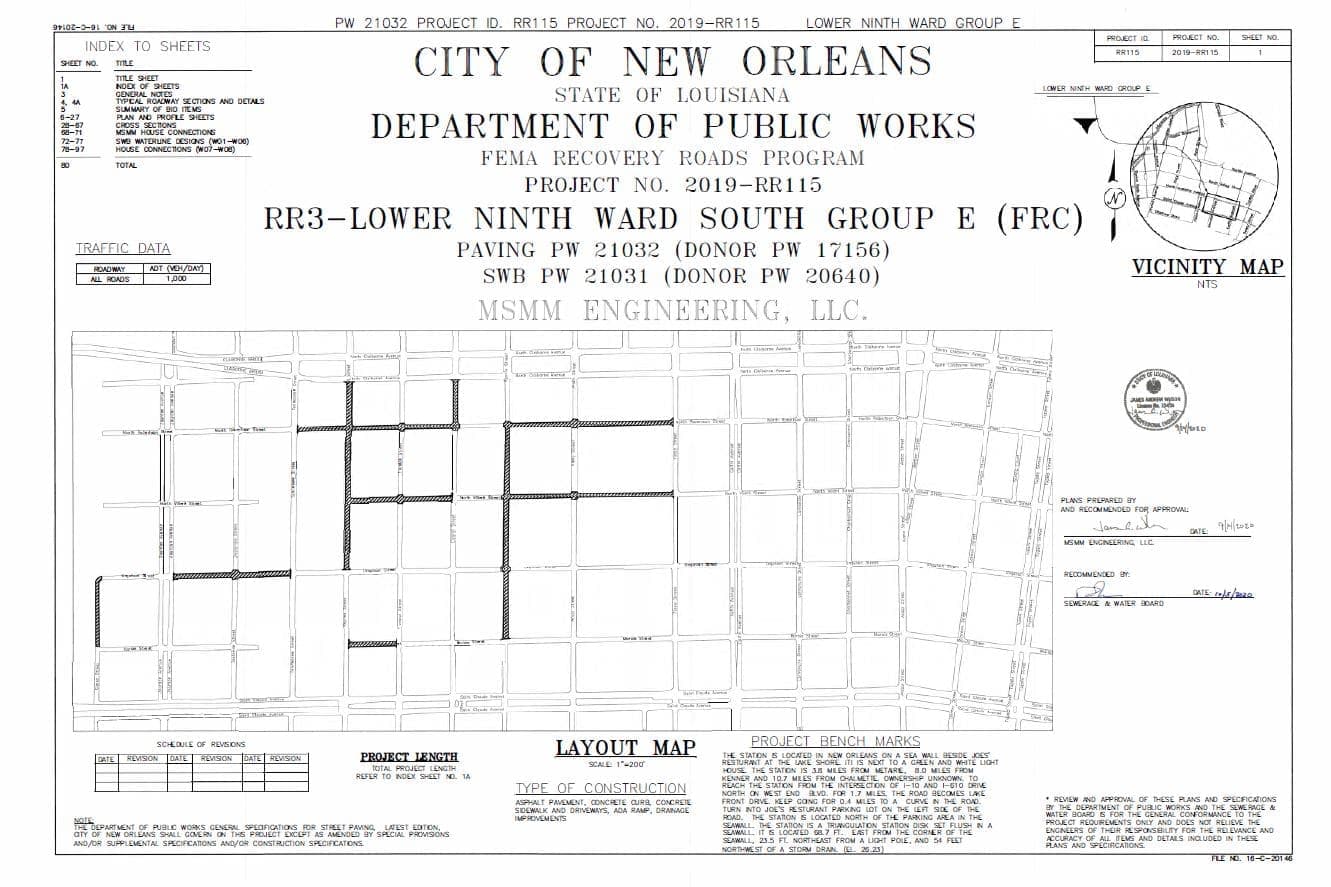
FEMA JIRR — Lower 9th Ward South Group E (RR115)
Public Infrastructure|Completed

FEMA JIRR — Lower 9th Ward South Group E (RR115)

MSMM was tasked by the City of New Orleans Department of Public Works with performing full engineering design services on multiple blocks of city streets within the West End neighborhood of New Orleans. As part of these design services, the MSMM civil engineering staff was responsible for all impacted concrete and asphalt streets, curbs, driveways, sidewalks, water and sewer relocations, water and sewer house services, catch basins, manholes, and stormwater pipe. In total, the design has encompassed more than 11.5 miles of City streets, at roughly 120 city blocks in the neighborhood bound by Ponchartain Boulevard, Veterans Boulevard and the 17th street canal on the New Orleans/Metairie line. MSMM was provided a general scope of eligible blocks determined by FEMA. From there, our engineers and field crew were responsible for evaluating the damages and creating an initial design layout for approval by FEMA. Once FEMA approved the specific scope of the project, our Civil Engineers performed the design replacement of multiple concrete and asphalt streets. In addition, intricate drainage design was generated to ensure proper stormwater mitigation of the residential lots and the roadway. The drainage design implements the rational method along with LADOTD hydraulics programs to generate a system that can properly withstand a 10-year 24-hour storm event. Lastly, our Civil Engineers executed the relocation, rehabilitation, and replacement of both the water lines and the gravity sewer lines. Upon completion of the design, the MSMM team of Civil Engineers and Project Managers have continued to aid the City of New Orleans by providing Contstruction Administration for the duratoin of the project. Tasks for Construction Administration promptly answering RFIs, preparing Field Changes and Plan Changes, running bi-weekly progress meetings, reviewing and approving Contractor Pay Applications, maintaining a strict construction schedle, and overall coordination and facilitation with all entities involved in the project.

Lower Ninth Ward, New Orleans, LA

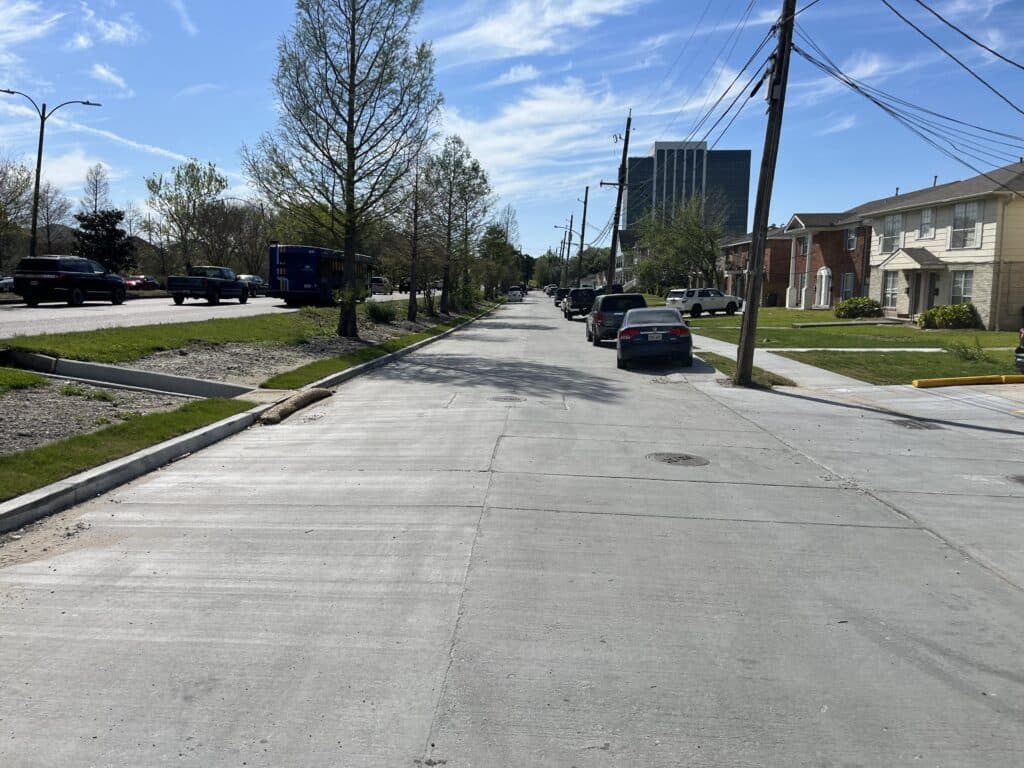
FEMA JIRR — West End
Public Infrastructure|Completed

FEMA JIRR — West End

MSMM was tasked by the City of New Orleans Department of Public Works with performing full engineering design services on multiple blocks of city streets within the West End neighborhood of New Orleans. As part of these design services, the MSMM civil engineering staff was responsible for all impacted concrete and asphalt streets, curbs, driveways, sidewalks, water and sewer relocations, water and sewer house services, catch basins, manholes, and stormwater pipe. In total, the design has encompassed more than 11.5 miles of City streets, at roughly 120 city blocks in the neighborhood bound by Ponchartain Boulevard, Veterans Boulevard and the 17th street canal on the New Orleans/Metairie line. MSMM was provided a general scope of eligible blocks determined by FEMA. From there, our engineers and field crew were responsible for evaluating the damages and creating an initial design layout for approval by FEMA. Once FEMA approved the specific scope of the project, our Civil Engineers performed the design replacement of multiple concrete and asphalt streets. In addition, intricate drainage design was generated to ensure proper stormwater mitigation of the residential lots and the roadway. The drainage design implements the rational method along with LADOTD hydraulics programs to generate a system that can properly withstand a 10-year 24-hour storm event. Lastly, our Civil Engineers executed the relocation, rehabilitation, and replacement of both the water lines and the gravity sewer lines. Upon completion of the design, the MSMM team of Civil Engineers and Project Managers have continued to aid the City of New Orleans by providing Contstruction Administration for the duratoin of the project. Tasks for Construction Administration promptly answering RFIs, preparing Field Changes and Plan Changes, running bi-weekly progress meetings, reviewing and approving Contractor Pay Applications, maintaining a strict construction schedle, and overall coordination and facilitation with all entities involved in the project.

West End, New Orleans, LA

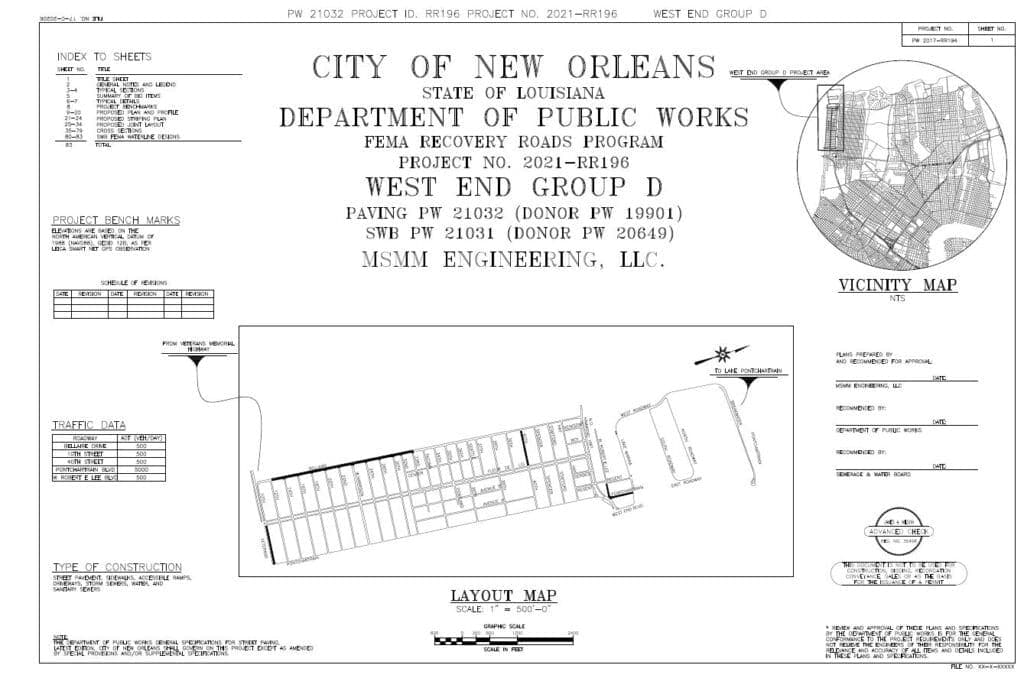
FEMA JIRR — West End Group D (RR196)
Public Infrastructure|Completed

FEMA JIRR — West End Group D (RR196)

MSMM was tasked by the City of New Orleans Department of Public Works with performing full engineering design services on multiple blocks of city streets within the West End neighborhood of New Orleans. As part of these design services, the MSMM civil engineering staff was responsible for all impacted concrete and asphalt streets, curbs, driveways, sidewalks, water and sewer relocations, water and sewer house services, catch basins, manholes, and stormwater pipe. In total, the design has encompassed more than 11.5 miles of City streets, at roughly 120 city blocks in the neighborhood bound by Ponchartain Boulevard, Veterans Boulevard and the 17th street canal on the New Orleans/Metairie line. MSMM was provided a general scope of eligible blocks determined by FEMA. From there, our engineers and field crew were responsible for evaluating the damages and creating an initial design layout for approval by FEMA. Once FEMA approved the specific scope of the project, our Civil Engineers performed the design replacement of multiple concrete and asphalt streets. In addition, intricate drainage design was generated to ensure proper stormwater mitigation of the residential lots and the roadway. The drainage design implements the rational method along with LADOTD hydraulics programs to generate a system that can properly withstand a 10-year 24-hour storm event. Lastly, our Civil Engineers executed the relocation, rehabilitation, and replacement of both the water lines and the gravity sewer lines. The West End Group D (RR196) Project is currently in the design phase and has not yet been awarded to a contractor for construction. However, once construction begins, MSMM will be providing Construction Administration and Resident Inspection for the project to assist and coordinate the construction process

West End, New Orleans, LA